AGROCONSCIENTE - Brazilian Agribusiness Success Worries Competitors and Benefits Consumers
Publicado em 18/06/2026
chatGPT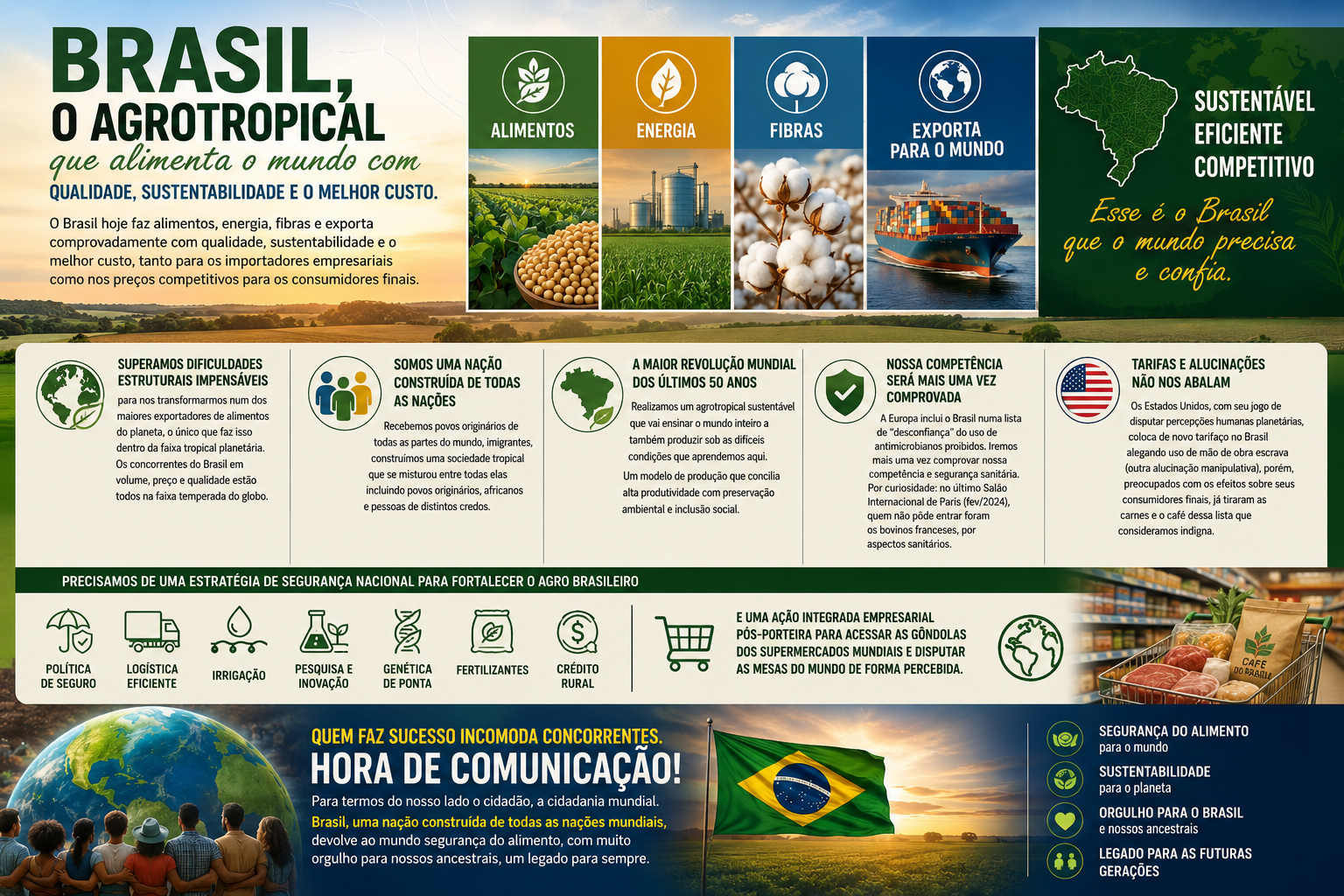 Brazilian agribusiness today produces food, energy, and fibers and exports them with proven quality, sustainability and cost efficiency
Published on June 8, 2026
Agriconscient Blog
*José Luiz Tejon
Translated / Copydesk by Teacher Francisco Barbosa Bardhal
Brazilian agribusiness today produces food, energy, and fibers and exports them with proven quality, sustainability and cost efficiency, offering competitive prices both to importing companies and to end consumers worldwide. We've overcome structural challenges once thought insuperable and transformed ourselves into one of the world's leader food exporters, the only country capable of achieving this scale of production along the planet's Tropical Belt.
Brazil's main competitors in terms of volume, price, and quality are all located in the temperate regions of the globe.
Consider it with due importance, Brazil is a nation built by indigenous peoples, courageous immigrants from every corner of the world, and generations of citizens who created a unique tropical society. Our culture reflects the contributions of peoples from Africa, Europe, and Asia, united by respect for diversity and different beliefs.
Over the past fifty years, Brazil has accomplished what may be considered the greatest agricultural revolution in modern history: the rise of sustainable Tropical Agriculture. Through determination, innovation, and relentless effort, we've learned how to produce efficiently under hard challenging tropical conditions. This experience will increasingly serve as a model for the rest of the world.
At this moment, Europe has placed Brazil on a list of countries under "heightened scrutiny" due to alleged concerns regarding the use of prohibited antimicrobials and their potential effects on human health. Yet, as ocurred on many previous occasions, Brazil will once again demonstrate its competence, transparency, and sanitary excellence of our agricultural sector.
Interestingly (it's important to point out) that during the International Agricultural Show held in Paris past February, it was French cattle, not Brazilian livestock, unable to take part of the event due to they failed reaching the sanitary requirements in force.
Meanwhile, the United States, amid its ongoing battle for global public perception, has once again imposed tariff measures against Brazil, citing allegations of "slave labor" practices, claims I regard as politically motivated and disconnected from reality.
However, concerned about consumer reactions and the potential impact on American households, U.S. authorities have already removed Brazilian beef and coffee from that list. Brazil urgently needs a comprehensive national strategy to strengthen critical pillars of agribusiness, including: Rural insurance policies, Logistics infrastructure, Irrigation systems, Agricultural research, Genetics and biotechnology, Fertilizer security, Rural credit and Financing.
At the same time, we need a stronger business integration beyond the farm gates, enabling Brazilian products to reach supermarket shelves worldwide and compete successfully for consumer preference globally. It's often said that success attracts resistance from competitors. If it's true, then Brazil reaches the right moment for strategic communication.
We must strengthen our connection with citizens and consumers around the world.
After all, Brazil, a nation built by immigrants from every region of the globe, is now proudly giving back something crucial to the humanity: Food Security. It's a legacy inherited from our courageous ancestors, aforementioned brave immigrants,and this legacy will endure for generations to come.
www.agricitizenship.com
José Luiz Tejon for the Agroconscient Movement
*José Luiz Tejon is PhD in Education from Universidad de La Empresa/ Uruguay. Master’s degree in Education, Art and Cultural History from Mackenzie Presbyterian University. Journalist and advertising professional, with specialization programs completed at Harvard University, Massachusetts Institute of Technology, PACE University, and INSEAD.
Columnist for several Brazilian radio networks, television programs, newspapers, magazines, and social media platforms, as well as the author and co-author of 37 books. Academic Coordinator of the Master of Science in Food & Agribusiness Management program offered by Audencia Business School in partnership with FECAP. Managing Partner of Biomarketing and TCA International.Vice President of the Fundação Brasileira de Marketing (FBM) and Associação dos Dirigentes de Vendas e Marketing do Brasil (ADVB). Head Agro Professional at ANEFAC and received the Personalidade Agro ABAG 2023 award. Previously,served as Director of the Grupo Estadão, Agroceres, and Jacto S/A.