1,300 farmers invest EUR 311 million annually in research
Publicado em 05/03/2026
Divulgação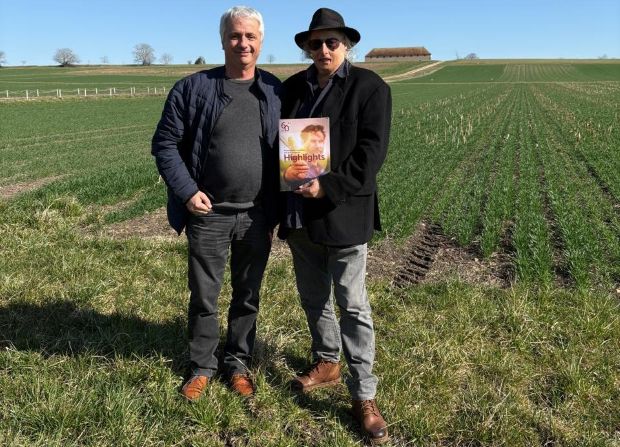 Prof. Tejon and Mr. Yannick Chassaing, farmer board member of Limagrain, from Clermont-Ferrand.
Published on February 27, 2026
Agriconscient Show – Broadcast by Radio Eldorado, Estadão – Brazil
*José Luiz Tejon
Translated/Copydesk by Teacher Francisco Barbosa Bardhal
After the monumental Paris International Agricultural Show, with its seven vast pavilions, what we encountered can only be described as a gigantic Scientific Revolution in Agribusiness: Genetic Research. Seeds are, and will continue to be , the essential code of the entire agribusiness system, from soils to plates, from the land to life itself. They represent the environment and health in every sense. Invisible, yet decisive, is Genetic Security.
In Clermont-Ferrand, region of France’s extinct volcanoes, a cooperative formed by 1,300 farmers today invests the equivalent of BRL 1.887 billion in seed research annually.
To put this into perspective, this single French cooperative, the exemplary Limagrain , invests annually nearly twice what we invest in Brazil in agricultural research. It's far greater than what we currently allocate to plant genetics in seeds.
While we're distracted and diverted from the vital and strategic priorities of Brazilian agribusiness by encouraged land invasions, ideological polarizations, the revocation of strategic river logistics decrees, and internal divisions across the entire agribusiness complex, from science to the final consumer here in France we're confronted with a strategic initiative and decision by a cooperative that began with 100 farmers in 1965 and today records annual revenues exceeding EUR 2.5 billion, and alone makes a massive investment in the Genetic Security of rural producers through seeds.
And why is this vital? Because it'll be achieved through seeds rapidly adapted to climate change, to the transformations of each microbiome; seeds developed for diverse and distinct agroindustrial and food purposes, across all fields.
In vegetables, gardens, trees, grains, animal feed, medicine, health, I mean in everything that originates, and will continue to originate, in fields, waters, and seas.
An investment of this magnitude, decided upon and sustained by 1,300 French farmers , challenges us. It forces us to reflect on how lacking we are in unified thinking focused on our vulnerabilities and on the speed with which we must act.
From the Paris Agricultural Show, through Clermont-Ferrand at Limagrain, here's a wake-up call: Speed, Brazil! A call for meetings aimed at joint and strategic decisions. And attention: mastery of Genetic Science will effectively determine the security of the entire agribusiness sector.
At the very least, my recommendation is that Brazilian cooperatives seek inter-cooperative collaboration in Genetic Science with this French cooperative.
In this field, above and beyond the EU–Mercosur agreement issue, we can, and must, begin immediately, alongside Embrapa, an Agrinational Genetic Security Program.
And why not through cooperative-to-cooperative? The future increasingly lies in the invisible, in genes and its editing. We must follow and participate in this state of the art of genomics.
And what I heard from a French farmer, Mr. Yannick Chassaing, board member of Limagrain, was: “We learned from you Brazilians, how you built a conservationist model agriculture, overcoming strong tropical challenges and here we replicate those resilient models. We have so much to accomplish together.”
Remarkable: 1,300 farmers investing BRL 1.887 billion annually in seed research for genetic security, operating worldwide today, including in Brazil.
Congratulations, Limagrain.
This is wisdom we must emulate, placing at the center the protection of our farmers and our national food security. Directly from the International Agricultural Show – Paris.
À bientôt!
*Prof. Dr. José Luiz Tejon – PhD in Education Universidad de La Empresa/Uruguay; Academic Director Brazil+Tropical Belt Nations at International Agribusiness MBA Audencia France & Fecap Brazil; Master's degree in Art Education and History of Culture - Mackenzie University; Journalist and Publicist - Harvard, MIT and PACE/USA/ Insead in France; Specialization Academic Coordinator of Master's Science Food & Agribusiness Management at Audencia in Nantes/ France, and FECAP/Brazil; Managing Partner at Biomarketing and TCA International; Professional Head at Agri Anefac; Writer, author and co-author of 37 books; Agri Personality Award 2023/ABAG -100 Most Influential People in Agribusiness; Former director of Grupo Estadão, Agroceres and Jacto S/A; 2025 Award Agriworld Group.