“Brazil Has a Secret Weapon Against the Crisis”, Reports The Economist
Publicado em 09/04/2026
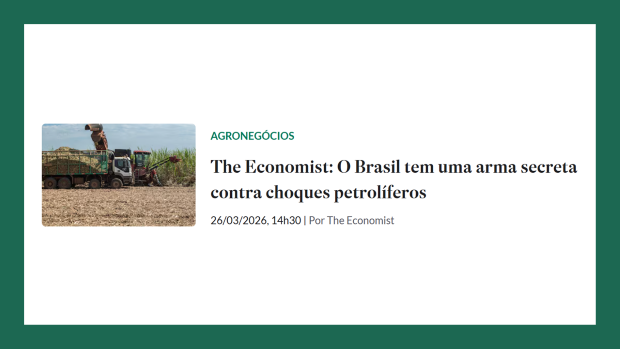 Brazil has a secret weapon against oil shocks: biofuels.
Published on March 30, 2026
Agriconscient Show – Broadcast by Radio Eldorado Estadão-Brazil
*José Luiz Tejon
Translated/Copydesk by Teacher Francisco Barbosa Bardhal
Last week (March 26), The Economist published an article stating: “With oil prices rising and a global energy crisis underway, driven by the war involving the United States, Israel, and Iran, Brazil holds a strategic advantage: biofuels.”
The British magazine emphasizes that “Brazil has a secret weapon against oil shocks, and biofuels will help the country face the effects of the conflict in the Middle East.” We can say: we aren't perfect, but we overcome. During the 70's oil shocks, Brazil was in a far more fragile position.
From that crisis emerged the Proálcool program, which gave rise to ethanol, along with major investments in Petrobras. Industry associations were also created, such as UNICA (the Brazilian Sugarcane Industry Association), under the presidency of Mr. Evandro Gussi, connecting ethanol and other sugar-energy derivatives. Likewise, Aprobio (the Brazilian Association of Biofuel Producers), led by Mr. Jerônimo Goergen, with former minister Mr. Francisco Turra as chairman, has played a key role, especially referring to biodiesel.
In its report, The Economist states that few countries are as prepared as Brazil to face this kind of challenge, adding that “Brazil has built the most sophisticated biofuels industry in the world.” This recognition, from a globally respected publication is highly significant.
At a time of increasing polarization, it reinforces Brazil’s image in global agribusiness. Sustainability and environmental responsibility have become central themes, and a country positioned in clean energy, such as Brazil’s biofuel model, adds positive value to the “Brazil Brand” and also to the broader agricultural supply chains.
The mentioned Economist's report notes Brazil blends 30% ethanol into gasoline and 15% biodiesel into diesel, “the highest levels in the world” and the fact of “three-quarters of light vehicles in Brazil are equipped with flex-fuel technology, capable of running on any mixture, from pure gasoline to pure ethanol.”
Despite this favorable assessment, fuel prices in Brazil have risen at the pump, which undoubtedly increases costs across all agrifood production chains. However, the publication highlights that “fuel prices in Brazil have increased, but remain incomparable to the spikes recorded in the United States and average of 30% for gasoline and 40% for diesel.”
I highlight this international report as recognition of a positive Brazilian achievement. Far from naive optimism, I align with the words of Ariano Suassuna, late renowned Brazilian writer and playwright (Auto da Compadecida, among other works), who once said: “The optimist is a fool, the pessimist is a bore. I am a hopeful realist.”
From this standpoint of a “hopeful realist,” we recognize we aren't perfect. Yet, throughout our history, we have overcome enormous and repeated crises. At this moment, speed is essential and strategic focus. We need agricultural machinery powered by biofuels. We urgently need a national biogas policy, with biodigesters producing biofertilizers and biomethane.
Key organizations such as Abiogás (the Brazilian Biogas and Biomethane Association) are already advancing concrete initiatives, including the construction of bioplants at the Primato cooperative in Toledo, Paraná, in partnership with MWM, a Tupy brand specializing in engine, energy, and sustainability technologies.
It's also urgent to implement Brazil’s National Fertilizer Policy. Investments in rail and waterway logistics, agro-industrialization, and effective communication strategies are equally critical. There's much to be done in Brazil’s ongoing development.
In difficult times, with sound judgment, we must demand strategic plans with measurable goals audited and executed through integrated public-private partnerships. Brazil’s internal divisions has been our greatest enemy so far.
Perhaps, with new governance beginning in 2027, we can achieve a “40 years in 4” development plan, at the speed the world demands and Brazil is fully capable of delivering.
*José Luiz Tejon PhD in Education from the Universidad de La Empresa/Uruguay, Master's degree in Education, Art and History of Culture from Mackenzie University, Journalist and advertising professional with specializations from Harvard, MIT, PACE/USA, and INSEAD in France. Columnist for Rádio Eldorado and Estadão On-line, and the author and co-author of 37 books. Academic Coordinator of the Master Science Food & Agribusiness Management program at Audencia in Nantes/France and FECAP/Brazil.Managing Partner at Biomarketing and TCA International. Vice-President of the Brazilian Marketing Foundation (FBM) and ADVB - the Brazilian Marketing Foundation and Association of Sales and Marketing Executives of Brazil. Head of Agro at ANEFAC. ABAG 2023 Agro Personality Award. Former director of Grupo Estadão, Agroceres, and Jacto S/A.