Without harmony, Brazil cannot become a melody
Publicado em 02/07/2026
Divulgação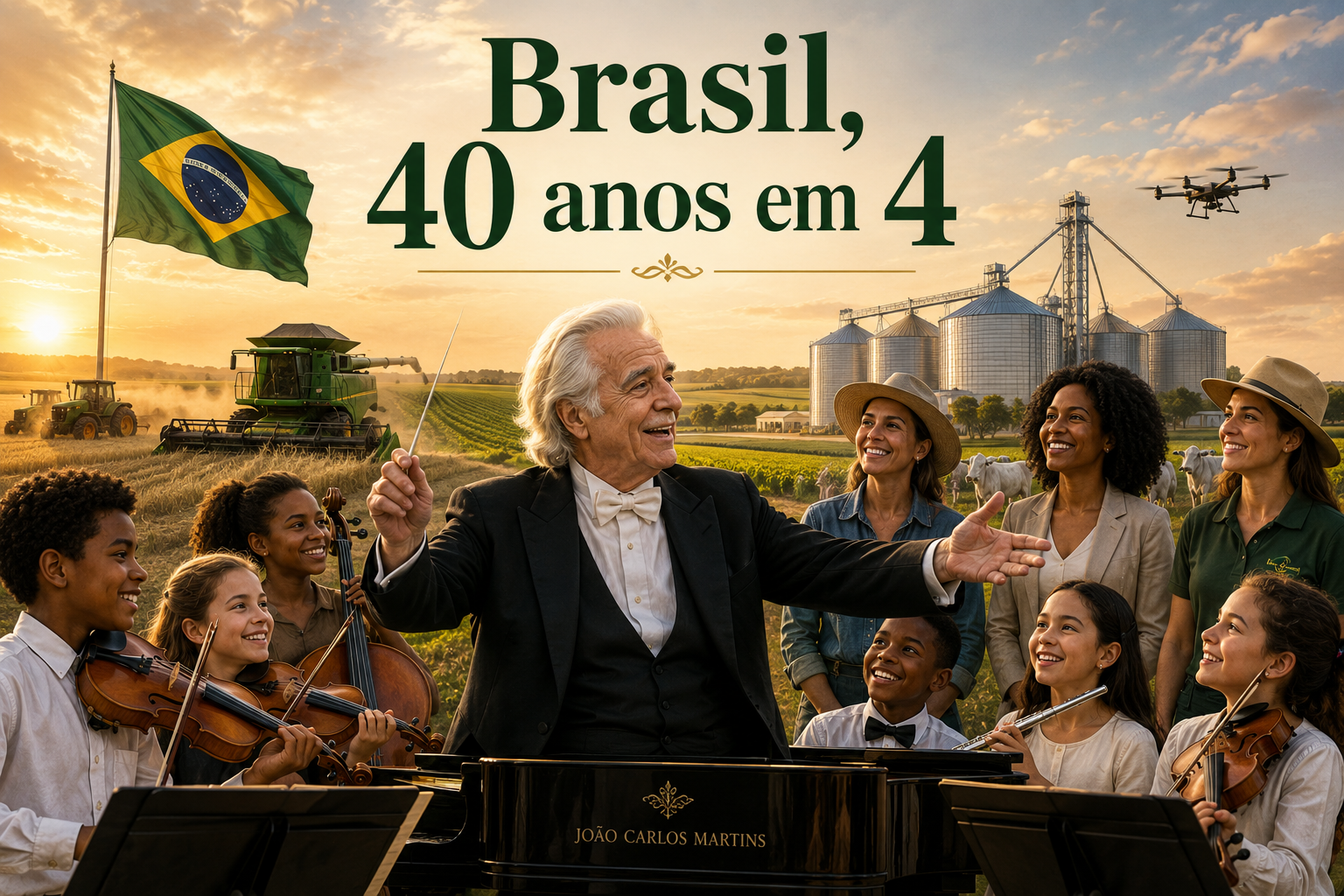 In Brazil's national motto, beyond order and Progress, one essential word is missing: harmony
Published on June 19, 2026
Agriconscient Blog - www.tejon.com.br
* José Luiz Tejon
Translated/Copydesk by Teacher Francisco Barbosa Bardhal
A Samba school cannot enter the avenue parade without the guidance of its harmony section. Anitta, Shakira, or Lady Gaga would not exist without the art of combining chords into melody. Otherwise, all we would hear would be cacophony. I'm taking about orchestration.
My dear friend, Maestro João Carlos Martins, regarded as one of the greatest interpreters of Bach in the twentieth century, understands perfectly that the success of a great pianist depends not only on his talent, but also on a conductor and an orchestra performing all together in plain harmony.
Brazil enjoys a positive international image, as revealed by the recent Brazil Brand Study conducted across 26 countries and all 26 Brazilian states, involving more than 470,000 respondents.
The country's strongest attributes emerged clearly: Nature, Warmth of its People, Tourism, and Food Production supported by an agribusiness sector already recognized worldwide.
These four elements, these four sections of our national "Samba School," must perform within the same melody and the same rhythm. Without leadership, without harmony coordination, we won't achieve the progress we deserve nor the speed we need to advance.
We're competing in a global environment filled with uncertainty, challenges, media disputes, propaganda battles, geopolitical noise, and clashes of egos. If we could hear the sound of the planet today, we would probably hear not a symphony, but a cacophony.
As Brazilian agribusiness has evolved into a global competitor to major economies, including the United States and the European Union, we can no longer rely solely on the well-deserved recognition earned through four decades of agricultural and agro-industrial excellence.
We must also adopt a sophisticated strategy for communicating the essence of Brazil, one capable of winning hearts and minds around the world. Brazil is the world's largest producer of citrus, a global leader in coffee, animal protein, cotton, fruits, pulp and paper, and grains that feed livestock across the planet.
We produce flowers, lychees, canola, wheat, sorghum, soybeans, corn, and palm crops. We're revitalizing rubber and cocoa production. We're global leaders in sugarcane and biofuels.
All of this has been achieved through a deep understanding of sustainability. Without it, Brazil could never have developed into the tropical agricultural powerhouse it is today while preserving one of the largest forest reserve systems on Earth, as satellite imagery consistently demonstrates.
But what does that mean if the world doesn't fully perceive us?Quality alone isn't enough. Quality must also be recognized. Our products originate from tropical technologies and world-class scientific research.
Recent examples include Dr. Mariangela Hungria, recipient of the 2025 World Food Prize ,often referred to as the "Nobel Prize of Agriculture", for her pioneering work on biological nitrogen fixation.
We have Embrapa and Cenargen, institutions that contribute to global genetic-resource preservation, including participation in the world's most important seed conservation initiatives, such as the Svalbard Global Seed Vault in Norway.
In 2026, ESALQ ( Higher School of Agriculture)celebrates its 125th anniversary, while its faculty head, Dr. Thaís Vieira, has been awarded France's prestigious Order of Agricultural Merit. These aren't isolated achievements.
They're the result of a tropical nation built by generations of immigrants who arrived fleeing from wars, hunger, persecution, and hardship. Together, these heroes helped create a unique tropical civilization, a remarkable blend of cultures and ethnicities unlike any other on Earth.
Therefore, without a long-term State strategy that aligns public and private efforts, Brazil won't achieve the full measure of progress available to for the next forty years. Keep doing exactly what we have done during the past fifty years, won't be enough.
A national strategic plan is essential. Such a plan would unite government communication efforts, private sector initiatives, and organized civil society into a common purpose.
Only then will we generate a powerful symphony of Voices, Songs, and Harmonies capable of transforming Brazil into a Compelling Melody to captivates hearts and minds across the globe.
And perhaps then we'll fully embody the vision expressed by Dr. Roberto Rodrigues: "Brazil is the Country of Peace, 'cause Food is Peace”. Brazilian agribusiness is an undeniable success story.
And for that very reason, deserves communication and promotion equal to its achievements so that reality isn't overshadowed by misperceptions. Together with Brazil's food and beverage industry, represented by ABIA( Brazilian Food Industry Association), which purchases approximately 65% of everything Brazilian agriculture produces and exports products to nearly 200 countries, we need a coordinated effort to transform Brazil into a beautiful melody heard and appreciated around the world.
Without harmony, Brazil cannot become a melody. Instead, we risk remaining trapped in the noise of cacophony. Order. Progress. Harmony.
*José Luiz Tejon is PhD in Education from Universidad de La Empresa/ Uruguay. Master’s degree in Education, Art and Cultural History from Mackenzie Presbyterian University. Journalist and advertising professional, with specialization programs completed at Harvard University, Massachusetts Institute of Technology, PACE University, and INSEAD. Columnist for several Brazilian radio networks, television programs, newspapers, magazines, and social media platforms, as well as the author and co-author of 37 books. Academic Coordinator of the Master of Science in Food & Agribusiness Management program offered by Audencia Business School in partnership with FECAP. Managing Partner of Biomarketing and TCA International.Vice President of the Fundação Brasileira de Marketing (FBM) and Associação dos Dirigentes de Vendas e Marketing do Brasil (ADVB). Head Agro Professional at ANEFAC and received the Personalidade Agro ABAG 2023 award. Previously,served as Director of the Grupo Estadão, Agroceres, and Jacto S/A.