Brazil & China: “Don't fear the market”, Fernando Penteado Cardoso
Publicado em 19/02/2026
Divulgação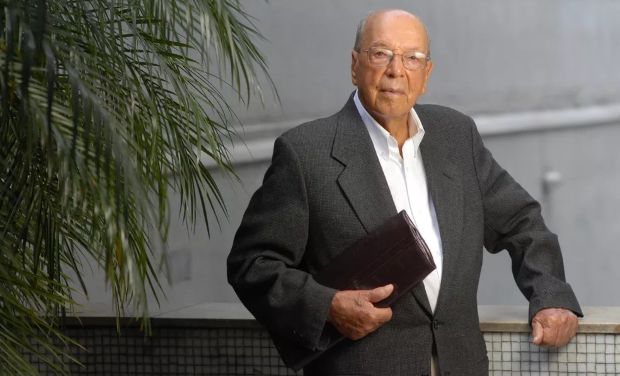 Dr. Fernando Penteado Cardoso, founder of Manah and creator of Agrisus (in memoriam)
Published on February 09, 2026
Agriconscient Show – Broadcast by Radio Eldorado Estadão – Brazil
*José Luiz Tejon
Translated/Copydesk by Teacher Francisco Barbosa Bardhal
“With Manah fertilizer, it works!” This memorable phrase, coined by the late Dr. Fernando Penteado Cardoso late founder of Manah, a legendary giant corporation in Brazil’s fertilizer sector , reflects his lifelong conviction.
He was also the creator of Agrisus (the Sustainable Agriculture Foundation) and, after his honoured 106 years of life and hands-on experience, he would say: “Do not fear the market; it is far bigger than you can see!”
I use this quote, which I heard directly from this Brazilian agricultural genius, because today many analysts trade in disaster narratives , a kind of market “Misery Forecasting” built on victimhood and fear. One example concerns Brazil–China relations.
China has become Brazil’s largest trading partner, representing 30% of all Brazilian agribusiness exports. Today, China accounts for nearly 80% of all Brazilian soybean exports , and it holds an almost equivalent level of dependence on Brazil as its supplier.
When we examine what brought together an ancient nation like China and a young country like Brazil, we find, on one side, an impressive state-driven strategic plan executed by China over the past 60 years — one of the greatest economic transformations in world history. From a GDP smaller than Brazil’s in 60's, China has reached nearly US$20 trillion nowadays, becoming the world’s second-largest economy, behind only the United States at approximately US$30 trillion.
In other words, China’s GDP is now almost ten times larger than Brazil’s.
During this same period, Brazil carried out its fantastic Tropical Agricultural Revolution. From food importer to became a global food exporter. Brazil’s food and beverage industry is now the world’s largest supplier of processed food by volume.
Alongside national heroes like the courageous agronomist aforementioned Dr. Penteado Cardoso, two historic milestones deserve special mention: First, in 2001, China joined the World Trade Organization (WTO), strongly supported by Brazilian diplomacy, which for 15 years had advocated for China’s admission. From that moment onward, trade relations between Brazil and China expanded exponentially.
Second, the rise of soybeans in Brazil , encouraged since the 1970s by Embrapa, with support from JICA (the Japan International Cooperation Agency), which promoted Brazil as a soybean supplier. This effort intensified after the 1971 Mississippi River drought in the US, which severely disrupted soybean supply to Japan, then a major importer.
Brazil’s Cerrado region became the frontier of this transformation, driven by resilient producers, entrepreneurial migrants, cooperatives, and Science.
Brazil rose to the podium of the world’s three largest agricultural producers. Today, we find ourselves amid tariff wars, the European Union–Mercosur agreement, and discussions over potential Chinese limits on imports, for example,regarding Brazilian beef.
I'm participating in a documentary on Brazil–China relations addressing food security, strategic partnership, the global repositioning of agribusiness, future leadership, and the evolving trends in bilateral relations. My view is clear: the Great Chinese Dragon sees in Brazil a young, innovative, and creative partner , the unique power within the planet’s Tropical Belt.
The two nations are mutually strategic. Their relationship encompasses economic, food, energy, and environmental security. Brazil has also maintained neutrality in geopolitical conflicts.
However, we must move up the value chain. We need to sell products that inspire China’s vast and increasingly sophisticated youth population to consume not only our “silent and anonymous commodities,” but Brazilian brands. We must move from being merely the “Breadbasket of the World” to becoming the “Supermarket of the World,” as Mr.João Dornellas, president of the Brazilian Food and Beverage Industry Association (ABIA), aptly states.
Coffee, Tropical fruits Juices. What an extraordinary market lies before us. From China, investments in logistics, fertilizers, and technology can help us to incorporate 40 million hectares of degraded pastureland into regenerative and fully sustainable agricultural production here in Brazil.
In an aggressive and uncertain global environment, serious relationships — especially those involving food security between nations — will carry one indispensable signature in every agreement: Trust, in an era marked by distrust.
Diversification is essential but maintaining and expanding relationships with existing clients is equally imperative.
I firmly believe in the continued growth of Brazil–China trade, with diversification of products. Above all, we must add value, build and promote Brazilian brands.
Strategic marketing expertise will be essential and vital to our success. China’s youth market will increasingly adopt Western consumption habits. Its 1.4 billion people, with an average age of 40, alongside India’s 1.471 billion people with an average age of 29( too young) are reason enough to conclude: There must be supply for this inexorable Mega-Demand.
Brazilian marketing intelligence, now is the time, brothers! Let us not fear the market.
Prof. Dr. José Luiz Tejon - PhD in Education – Universidad de La Empresa (Uruguay). Academic Director Brazil+Tropical Belt Nations – International Agribusiness MBA (Audencia France & FECAP Brazil). Master’s Degree in Art Education and Cultural History – Mackenzie University. Journalist and Publicist – Advanced Programs at Harvard, MIT, PACE (USA), and INSEAD (France) Academic Specialization Coordinator – Master of Science in Food & Agribusiness Management (Audencia, Nantes/France & FECAP/Brazil). Managing Partner – Biomarketing & TCA International. Professional Head – Agri ANEFAC Author and Co-author of 37 books. Agri Personality Award 2023 – ABAG (Top 100 Most Influential People in Agribusiness) Former Director – Grupo Estadão, Agroceres, and Jacto S/A. Agriworld Group Award 2025.