Brazil: The largest tropical life bank for global life
Publicado em 25/06/2026
Divulgação Embrapa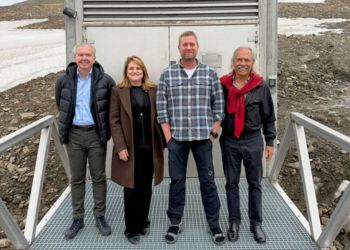 Embrapa President Ms.Silvia Massruhá has delivered another shipment of Brazilian seeds to the Global Seed Vault in Svalbard, Norway.
Published on June 13, 2026
Agriconscient Blog - www.tejon.com.br
*José Luiz Tejon
Translated/Copydesk by Teacher Francisco Barbosa Bardhal
Congratulations to Ms.Silvia Massruhá, alongside Mr.Elcio Guimarães, Embrapa researcher; Mr.Rodrigo Azeredo Santos, Brazil's Ambassador to Norway; Mr.Spen representative of NordGen(Nordic Centre for Genetic Resources).
This is precisely the kind of achievement that deserves coverage by the world's media and deserves to be understood by every Brazilian citizen for what it truly represents: Brazil's contribution to the security of life on Earth.
In Svalbard, Norway, there's a global repository of life, a place where seeds from all around the world are preserved under the highest security levels.
The reason is easy to understand: Throughout Earth's history, civilizations have witnessed natural disasters, climate shifts, conflicts, and unforeseen biological threats.
Therefore, safeguarding the future of life requires protecting genetic resources in a location designed to withstand climatic events, wars, and unexpected crises. That place exists: the Svalbard Global Seed Vault.
And what role does Brazil play in this? Brazil is home to the world's largest repository of tropical genetic resources.
Here we have Cenargen—the National Center for Genetic Resources and Biotechnology, located in Brasíliaand for its role, this institution deserves the recognition and respect of citizens worldwide.
On June 10, Embrapa President Ms.Silvia Massruhá delivered another Brazilian seed collection to Svalbard.
According to researcher Mr.Elcio Guimarães, the shipment included 24 new accessions: cashew (2), peanut (4), castor bean (3), lima bean (7), and sesame (8).
These additions join the 8,125 Brazilian seed species already deposited in that vital Norwegian facility. Silvia Massruhá also reported that Brazil now has samples representing more than 65 species preserved in that vault.
Even more impressive is the fact that Cenargen itself safeguards more than 23,000 seed accessions, making it the largest tropical genetic resources bank in the world.
Brazil is a nation of life, indeed. In the recent Brazil Brand Perception Study, conducted across 27 countries with 470,000 respondents, Brazil was recognized for its Nature, its warm and welcoming people, its tourism potential, its food production, and what should be called Agricitizenship.
At the Global Seed Vault in Norway, one inscription reads: “A gift to humanity and a symbol of peace.” As our agribusiness hero Dr. Roberto Rodrigues often says: “Food is peace, and Brazil feeds the world.”
I congratulate the founders of Cenargen, Embrapa, its researchers, and all members of its dedicated staff. I also encourage everyone involved in the agribusiness system to increasingly embrace and promote the concept of Agricitizenship, a term that deserves visibility, recognition, and dissemination.
This is the kind of story that merits ethical prominence across social media, newspapers, magazines, radio, and television as well. And why not imagine a documentary for global audiences, one capable of inspiring the world with the story of a Brazil that helps safeguard life itself? Shall we make it happen?
Brazil, a nation of peace and life, is composed of peoples from every corner of the globe. And to the world, we return a vital contribution: Food Security and the preservation of life.
Beyond being one of the world's three largest agricultural producers, Brazil also plays a crucial role in preserving the largest collection of tropical genetic resources essential to the future of global life.
What an honorable and dignified story for all of us, especially in times marked by division, conflict, anger, hatred, and polarization. “Order and Progress” are the words written on Brazil's flag and I would add one more:harmony!
Without harmony, we don't create a symphony, we only play an untuned cacophony.
José Luiz Tejon for Agroconscient.
*José Luiz Tejon is PhD in Education from Universidad de La Empresa/ Uruguay. Master’s degree in Education, Art and Cultural History from Mackenzie Presbyterian University. Journalist and advertising professional, with specialization programs completed at Harvard University, Massachusetts Institute of Technology, PACE University, and INSEAD.
Columnist for several Brazilian radio networks, television programs, newspapers, magazines, and social media platforms, as well as the author and co-author of 37 books. Academic Coordinator of the Master of Science in Food & Agribusiness Management program offered by Audencia Business School in partnership with FECAP. Managing Partner of Biomarketing and TCA International.Vice President of the Fundação Brasileira de Marketing (FBM) and Associação dos Dirigentes de Vendas e Marketing do Brasil (ADVB). Head Agro Professional at ANEFAC and received the Personalidade Agro ABAG 2023 award. Previously,served as Director of the Grupo Estadão, Agroceres, and Jacto S/A.
]