Advertising: the Art of Emotion Fertilizing Reason
Publicado em 06/08/2026
TCAI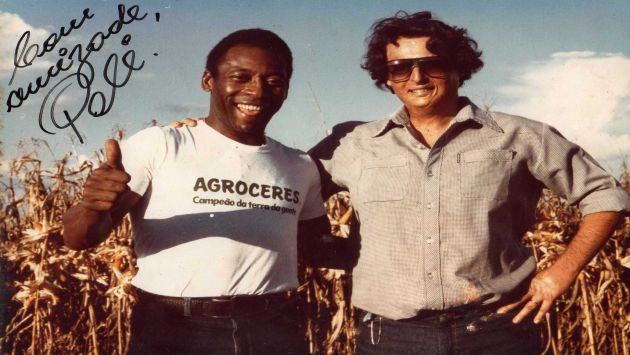 "With a ball at my feet, I am Pelé. With Agroceres in your fields, you, the farmer, are the Champion."
Published on July 31, 2026
Agriconscient Blog – www.tejon.com.br
*José Luiz Tejon
Translated/Copydesk by Teacher Francisco Barbosa Bardhal
One day I spoke with the late King Pelé and told him that Brazil needed to produce much more food. "We're importing food, Pelé! I work for a corn seed company, and if Brazilian farmers could achieve the same level of excellence in corn production that our Soccer champions display on the field, we could double the country's corn productivity." I told him.
It was 1982, and Pelé accepted the challenge.
The television commercials featured Pelé introducing champion farmers and declaring: "With a ball at my feet, I am Pelé. With Agroceres in your fields, you, the farmer, are the Champion." The campaign became an extraordinary success in promoting the adoption of hybrid corn seeds. In a single growing season, advertising accomplished what would otherwise have taken years.
Advertising Transforms
Advertising changes the world at remarkable speed. It transformed eggs, from being considered villains because of cholesterol into widely recognized nutritional allies. It transformed coffee, from being viewed as harmful to health during the 1980s into a symbol of inspiration, a meaningful pause, and a better quality of life.
Without advertising, companies must rely solely on product development, sales efforts, logistics, retail distribution, and competitive pricing. Without advertising, results rarely come at the desired pace. Rice offers us a classic example: As consumers' income rises per capita, rice consumption tends to decline. What is missing is value-based advertising, an advertising that inspires emotion and elevates rice from being merely a side order to become the centerpiece of a meal.
And what about advertising Brazilian tropical agricultural products? We simply don't have it. It's only fair to recognize the tireless efforts of Brazil's agricultural attachés around the world, who serve as true ambassadors on the front lines.
Likewise, a tribute is due to the outstanding work of ApexBrasil (Brazilian Trade and Investment Promotion Agency) at international trade fairs and exhibitions.
We perform well in institutional promotion, government initiatives, and B2B relationships. However, it won't be enough to drive Brazilian agribusiness into from now on.
We Must Show Our Agribusiness to the World
We must move the world emotionally by revealing the people behind the production of food, fiber, and renewable energy.
We must tell the story of origin, where our products come from and who produces them. We need the world to understand that Brazil's agricultural system was built by people whose ancestors came from the very countries that are now our customers.
Those courageous immigrants blended their cultures into a unique tropical wisdom. They developed conservation agriculture, no-till farming, biological nitrogen fixation, and techniques capable of transforming poor tropical soils into highly productive farmland. Our ancestors first had to produce fertile soil before they could produce food, fiber, and energy.
They learned how to farm sustainably, regenerating the land to harvest two and even three crops per year.
And that is how Brazil pioneered Integrated Crop-Livestock-Forestry (ICLF) systems.
Heroes of Tropical Agribusiness
Brazil's outstanding former Ministers of Agriculture, Dr. Cirne Lima and the late Dr. Alysson Paolinelli, sent one thousand Brazilians abroad to study, with the mission of bringing knowledge home and adapting it to tropical conditions. Now that Brazil has become the world's leading agricultural exporter, we have the responsibility to use the legitimate power of advertising, thr one to reache consumers' hearts before reache their minds, in more than 200 countries supplied by Brazilian food, renewable energy, fiber, commodities, and value-added agro-industrial products.
How Do We Do It?
Quite simply. For decades Brazil has won some of the world's most prestigious advertising awards at the Cannes Lions International Festival of Creativity. We have extraordinary creative talent.We have music, we have art and also personalities admired around the globe. In 1982, Pelé promoted hybrid corn seeds.
In 2026, Pelé was honored during the FIFA World Cup celebrations. Ronaldinho Gaúcho and Ronaldo Fenômeno appeared alongside Shakira before a global audience of approximately 1.6 billion viewers. Anitta performed at the tournament's opening ceremony before millions of young people around the world and Brazilian UFC champion Paulo Borrachinha even received praise from President Trump.
Yet we failed to seize the opportunity. Imagine if a simple Paulo Borrachina glove had displayed the phrase: "I Love Brazilian Tropical Food." That spontaneous media exposure alone would have been priceless. The same happened with Ayrton Senna and also we have barely showcased Rayssa Leal, one of skateboarding's greatest global stars.
What Brazil Has to Show the World
Brazil has ESALQ (Luiz de Queiroz College of Agriculture – University of São Paulo), celebrating its 125th anniversary as the world's fourth-ranked Agricultural Sciences Institution. We have CENARGEN, home to the world's largest tropical genetic resources collection.
We have Brazil's spectacular Samba Schools, delivering performances of breathtaking harmony, artistry, and precision.
Brazil has so much capable of moving the entire world emotionally.
Affection, Nature, Tourism, and Food
According to the Brand Brazil survey conducted by OnStrategy in 26 countries, Brazil is primarily associated with nature, warm and welcoming people, tourism, and food. An interesting finding emerged when comparing women's perceptions with the survey average.
Women's perceptions of Brazil proved even stronger and more positive. That makes me imagine what an athlete like Rebeca Andrade, whose sportsmanship is admired worldwide, could communicate directly to consumer's hearts.
And now, during the FIFA Women's World Cup, how much inspiration could the famous Soccer player Marta offer the world?
Just as King Pelé once inspired Brazilian farmers, Marta has the power to inspire the world by showing the dedication of Brazilian women farmers who genuinely love what they do, and whose passion helps produce some of the healthiest food on Earth. "With a ball at my feet, I am Marta. With Brazil in the fields, the world becomes the Champion." Let's play it again!
Investing in Brazil's Agricultural Brand
Achieving these goals requires investment. Brazil's official government advertising budget for this year is expected to approach R$1 billion. If only 25% of that amount were strategically invested in a national Tropical Agribusiness Advertising Program targeting consumers in our export markets, it would generate invaluable awareness of Brazil's contribution to global food security.
That investment would become genuine seed money, sustained over time and reinforced by contributions from businesses operating both before and beyond the farm gate. The Brazilian Association of Pork Producers (ABCS) provides us an outstanding example. Under the leadership of President Marcelo Lopes, gathering slaughterhouses and supermarkets, and with the brilliant marketing work of Ms. Lívia Machado, the organization successfully doubled Brazil's per capita pork consumption.
Beyond Commodities, Beyond Our Borders
Since 2016, I have participated in international conferences and academic programs throughout Europe, particularly at a French business school. Together with my students, I have observed how countries increasingly associate food with culture, identity, and place of origin, the essence of terroir.
Brazil's future goes beyond commodities. Increasingly, we must develop and promote our own distinctive tropical terroirs.
Why not begin at the Paris International Agricultural Show in February 2027? That would be an excellent starting point.
Advertising: The Best Response to Detractors and Polarization
Without the timeless art of advertising, we will lose valuable time, create opportunities for competitors, and—far worse—leave room for organized detractors fueled by ideological polarization. Even Ms. Ursula von der Leyen, President of the European Commission and one of the strongest advocates of the EU–Mercosur Agreement, was reportedly unaware of many of the objections raised against Brazilian beef in Europe.
That fact alone demonstrates the strategic urgency of developing an effective advertising strategy for Brazilian tropical agribusiness, especially if we intend to double its size over the next twelve years.
The World Lives Inside Brazil
"Brazil holds the entire world within its borders." Our mission isn't merely to present Brazil to the world. Our greater mission is to show how the world itself became more Brazilian. Brazil is a nation built by people from virtually every corner of the globe. Together they transformed land once dismissed as impossible to farm.
Not long ago, a popular Brazilian saying declared: "Cerrado land is worth neither inheriting nor receiving as a gift."
Interestingly today, that same land feeds the world. Long live Brazil, the only country on Earth named after a tree.
Tropical agribusiness is no longer a dream. It is reality. And realities that aren't perceived inevitably generate frustration, delay, victimhood, and loss of focus. In 1488, Portuguese navigator Bartolomeu Dias rounded the Cape of Storms. King John II of Portugal immediately renamed it the Cape of Good Hope. The route to India had been opened. Same way,Brazil has now opened the way for the entire Global Tropical Belt. The future of the world lies here.
We've already accomplished the hardest task: building sustainable Tropical Agriculture. Now it's time to do the easiest part: to tell the world the truth and earn the admiration this achievement deserves. That’s advertising, That's all, folks!
*José Luiz Tejon is PhD in Education from Universidad de La Empresa/ Uruguay. Master’s degree in Education, Art and Cultural History from Mackenzie Presbyterian University. Journalist and advertising professional, with specialization programs completed at Harvard University, Massachusetts Institute of Technology, PACE University, and INSEAD.
Columnist for several Brazilian radio networks, television programs, newspapers, magazines, and social media platforms, as well as the author and co-author of 37 books. Academic Coordinator of the Master of Science in Food & Agribusiness Management program offered by Audencia Business School in partnership with FECAP. Managing Partner of Biomarketing and TCA International.Vice President of the Fundação Brasileira de Marketing (FBM) and Associação dos Dirigentes de Vendas e Marketing do Brasil (ADVB). Head Agro Professional at ANEFAC and received the Personalidade Agro ABAG 2023 award. Previously,served as Director of the Grupo Estadão, Agroceres, and Jacto S/A.