Brazilian Agri Exporters: Trump's “Growing Annoyance”
Publicado em 30/07/2026
Divulgação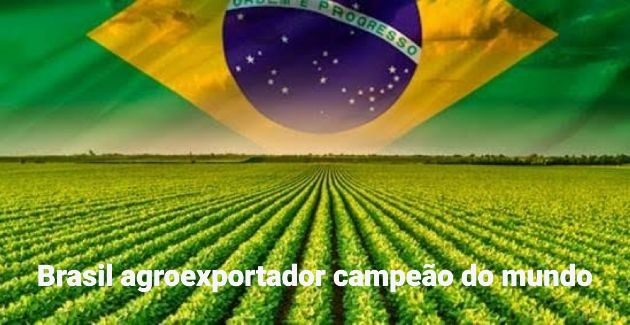 Brazil Heading to the World Cup in Agricultural Fields
Published on July 22, 2026
Agriconscient Blog
*José Luiz Tejon
Translated/Copyedited by Teacher Francisco Barbosa Bardhal
Who’d have imagined a country with an economy amounting to only about 8% of the U.S. GDP could, in just five decades,could become the world's second-largest agricultural exporter, and now stand on the path of claiming the Global Agri Championship Trophy as the world's leading agri-exporting nation?
For a U.S. president like Donald Trump, whose leadership style has consistently emphasized American supremacy across multiple sectors, this achievement is likely to be deeply unsettling. More than any political argument, it may explain us the aggressive tariff measures directed over Brazil products.
The Irony: Brazil import more than exports to USA
Brazil keeps importing more from the United States than vice-versa. Moreover, much of what Brazil sells to the U.S. consists of raw materials and industrial inputs that generate substantial added value within the American economy. And this isn’t refers to coffee, but also to industrial components, machinery, construction materials, and uncountable other sectors.
Brazilian exports support American manufacturing, reduce production costs, benefit U.S. Consumers, and strengthen the competitiveness of American exports in global markets specially against increasingly strong European and Asian competitors.
An excellent article lately published by the Brazilian business newspaper Valor (July 22, 2026), titled "U.S. Agricultural Hegemony Under Challenge," mentioned data from the U.S. Department of Agriculture (USDA) showing only US$2 billion now separates total U.S. agricultural exports from Brazil's.
Brazilian Agro continues to grow while U.S declines
More importantly, the trend lines reveal Brazil continues to grow while U.S. agricultural exports shows declining.
Brazil therefore represents a remarkable global case study: a developing nation located in the Earth‘s Tropical Belt successfully challenging the Long-Established Agricultural Powers of the temperate world and is about to become, in 2026, the world's largest agricultural exporter.
Brazil Heading to the World Cup in Agricultural Fields
While Brazil hasn’t recently achieved comparable success on the FIFA World Cup football fields, our agribusiness sector has demonstrated extraordinary resilience, competitiveness, and an exceptional ability to overcome challenges (no matter how many unfair “ red cards) the true champions in the fields, quite literally.
Another factor likely contributing to this "Trump concern" is Brazil's growing role as a pillar of global food and energy security.
Today, Brazil is the largest food supplier to China, America's main strategic competitor, and also a major supplier to Iran, another nation frequently at odds with U.S. foreign policy and nowadays at war.
Strategic Planning Must Remain Brazil's Priority
Brazil nevertheless faces enormous domestic challenges, making it essential, as former Minister and Senator Ms.Tereza Cristina often reminds us: "keep our feet firmly on the ground."
This requires comprehensive strategic planning through the entire agribusiness value chain, from the "A" of Avocado to the "Z" of Zebu cattle.
Before the farm gate, priorities include fertilizers, irrigation, agricultural inputs, genetics, mechanization, satellite connectivity, digital technologies, and artificial intelligence. Beyond the farm gate, Brazil must continue investing in storage, logistics, biofuels to power agricultural mobility, agro-industrialization, branding, and international marketing, bringing not only Brazilian commodities but also our exceptional tropical terroirs to global consumers, alongside the country's extraordinary natural heritage.
Within the farm gate, priorities remain equally clear: expanding Rural Insurance, strengthening producer protection, promoting cooperatives, reinforcing rural associations and producer organizations, while fostering constructive dialogue between producers, suppliers, processors, and buyers.
AgriWomen: An Exponential Growth Factor
Women's leadership is becoming one of the most transformative powers in global agribusiness.
A major milestone in this movement will be the World Agribusiness Women Leadership (WAWL) event to be held on October 2 during the Global Agribusiness Festival (GAFFFF) - Forum, Food, Festival & Fellowship at Nubank Park, in São Paulo.
Dialogue Above Tariffs and Polarization
Brazil needs dialogue far more than tariff escalation, political polarization, or ideological confrontation, conflicts history has repeatedly shown to be counterproductive.
History also reminds us that leaders consumed by ego and resentment rarely leave admirable legacies. Emperor Commodus of ancient Rome remains one typical example.
Our focus should remain on Brazil's role in serving the world through a mission of peace, as Dr. Roberto Rodrigues has so often emphasized to those, unsettled by Brazil's growing success, might simply say: "Let those who are uncomfortable step aside."
Congratulations to Brazilian agribusiness, an extraordinary team of champions, working in the service of peace and advancing toward the World Cup of agricultural exports.
What a remarkable team!
*José Luiz Tejon is PhD in Education from Universidad de La Empresa/ Uruguay. Master’s degree in Education, Art and Cultural History from Mackenzie Presbyterian University. Journalist and advertising professional, with specialization programs completed at Harvard University, Massachusetts Institute of Technology, PACE University, and INSEAD.
Columnist for several Brazilian radio networks, television programs, newspapers, magazines, and social media platforms, as well as the author and co-author of 37 books. Academic Coordinator of the Master of Science in Food & Agribusiness Management program offered by Audencia Business School in partnership with FECAP. Managing Partner of Biomarketing and TCA International.Vice President of the Fundação Brasileira de Marketing (FBM) and Associação dos Dirigentes de Vendas e Marketing do Brasil (ADVB). Head Agro Professional at ANEFAC and received the Personalidade Agro ABAG 2023 award.Previously,served as Director of the Grupo Estadão, Agroceres, and Jacto S/A.